Qualifying Income Shouldn't Be a Surprise at Underwriting


Most mortgage files carry two income numbers. The first is the one the borrower gives the loan officer at application: what they earn. The second is the one underwriting arrives at weeks later: what counts toward qualification. When those two numbers match, nobody notices. When they don't, the gap shows up at the worst possible moment, after the rate is locked, the disclosures are out, and the borrower is planning a move.
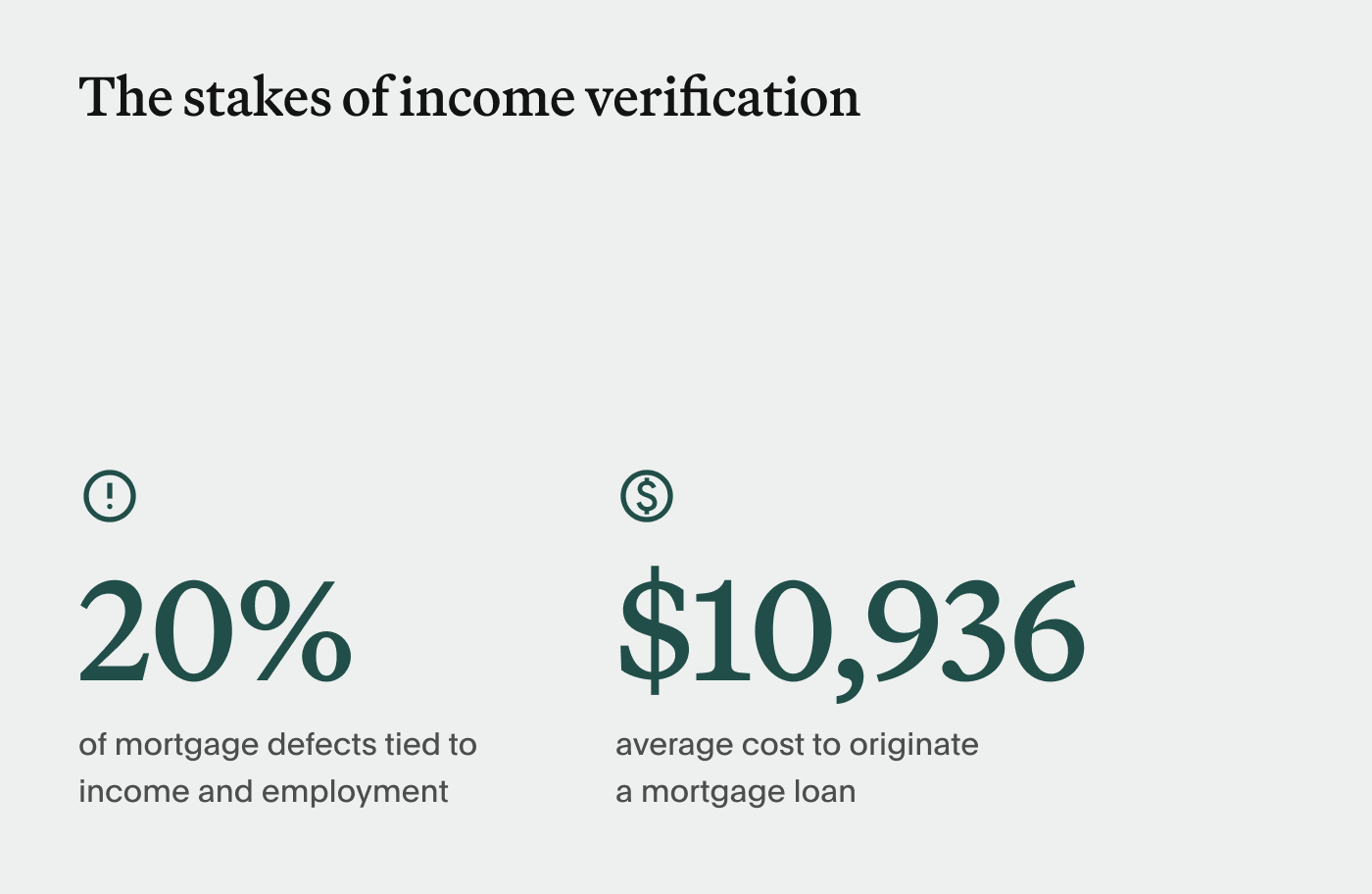
Income remains one of the most persistent sources of trouble in a loan file. In ACES Quality Management's Q1 2026 Mortgage QC Industry Trends report, income and employment issues made up roughly 20% of all defects, second only to legal and compliance issues, after years as the top category. The same report found the overall critical defect rate climbed to 1.71%, the largest quarter-over-quarter jump in four years. Fannie Mae's June 2026 Quality Insider ranked misrepresentation of income as the second most common defect in its random sample of loans acquired in the back half of 2025, with incorrect base income calculation at number seven.
At an average of $10,936 to originate a loan and a pre-tax profit of $973, there isn't much room to absorb a file that has to be rebuilt late in the process. The fix isn't to calculate faster in underwriting. It's to know qualifying income much earlier.
Where the gap between stated and qualifying income comes from
Borrowers aren't usually wrong about what they earn. They're answering a different question. Qualifying income follows agency rules about history, stability, and averaging, and most borrowers have never read them. The gap tends to open in the same places:
- Variable pay. Overtime, bonus, and commission often need a documented history and may be averaged over time. A borrower who had a great Q3 will quote the great Q3.
- Multiple employers. A second job or a recent job change adds a second set of pay history, and sometimes a second set of rules.
- Pay frequency and timing. Biweekly vs. semimonthly, partial pay periods, and a mid-year raise all change the math, and they're easy to get wrong on a manual worksheet.
- Recent changes. A promotion, reduced hours, or a gap in employment can move the qualifying number in either direction.
None of these are unusual. They describe a large share of the working population, and a large share of purchase borrowers. As Enact's Mary Kay Scully put it earlier this year, income errors "often surface late in the process," where fixing them means re-verification, borrower follow-ups, and pipeline bottlenecks.
What finding out late costs you
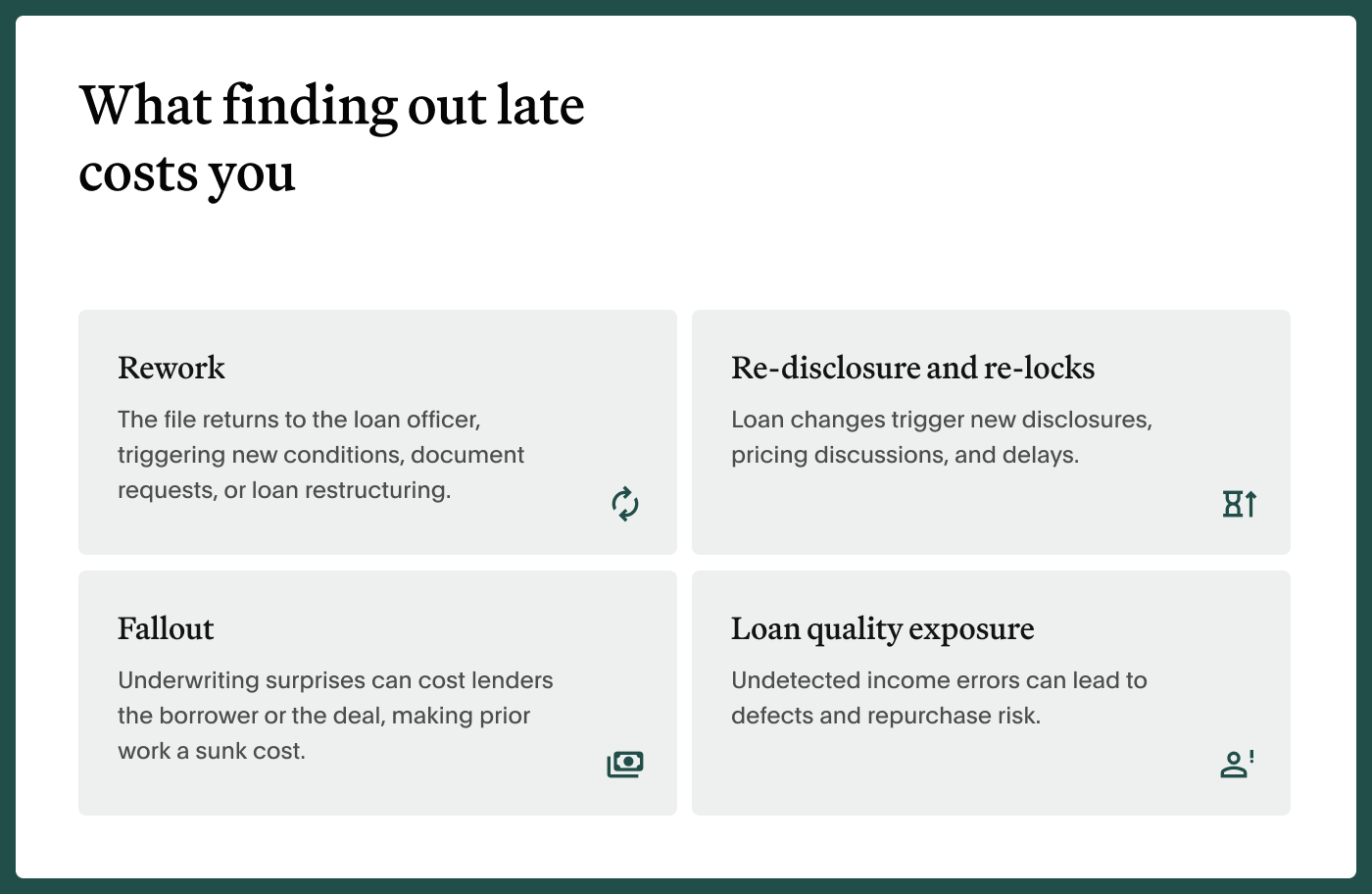
When qualifying income comes in below what the loan was structured on, the downstream work is predictable and expensive.
Rework. The file goes back to the loan officer and processor. Conditions get added, documents get re-requested, and the loan may need to be restructured, with a different program, a different loan amount, or a co-borrower.
Re-disclosure and re-locks. A changed loan means new disclosures and, often, a new pricing conversation, adding days to a timeline the borrower and the real estate agent are already watching.
Fallout. In a purchase market, a surprise at underwriting is how borrowers end up with another lender, or no house. All the work that went into the file up to that point is sunk cost.
Loan quality exposure. Income that's miscalculated and not caught becomes a defect finding later. That's a repurchase conversation, not a pipeline conversation.
Every one of these costs grows the later the gap is found. So the question for lenders isn't whether income gets calculated correctly. It's when.
Moving the qualification of income earlier in the process
Getting to qualifying income early takes two things, and most workflows only have one of them at application.
1. Income data straight from the source. Stated income and a couple of uploaded paystubs leave a lot of room for interpretation. When applicants connect their payroll accounts and share their income and employment records directly from the source, you start with complete pay history: earnings by type, pay dates, and employer details. That data is high-trust because of where it comes from. With Argyle's consumer-permissioned verification platform, applicants direct the sharing of their own records, at the start of the process, in a few minutes.
2. The GSE qualifying income calculation. Source data tells you what the borrower has been paid. It doesn't tell you what the GSE will count. Freddie Mac's Asset and Income Modeler (AIM) assesses eligible income, including base, overtime, bonus, and commission, using employment data. For eligible loans assessed through Loan Product Advisor, Freddie Mac offers representation and warranty relief on the accuracy of the income calculation, subject to its Guide requirements.
Put those two together at application and the gap between stated and qualifying income stops being a surprise. It becomes something your loan officer can see, explain, and structure around on day one.
What changes when everyone sees the number earlier
Earlier qualifying income isn't just an underwriting improvement. It changes the work across the whole team:
- Loan officers can set accurate expectations at pre-approval, structure the loan correctly the first time, and have the harder conversation (a lower amount, a different program) before the borrower is emotionally committed to a house.
- Processors spend less time chasing documents and clearing income conditions on files that were never going to qualify as structured.
- Underwriters review a file where the income picture already matches, instead of rebuilding it from scratch.
- QC and secondary teams see fewer income findings downstream and fewer files that close on a number nobody fully checked.
- Borrowers get a cleaner, faster experience, with fewer requests for "one more paystub" and fewer surprises at the closing table.
Where Argyle Direct VOIE+ fits
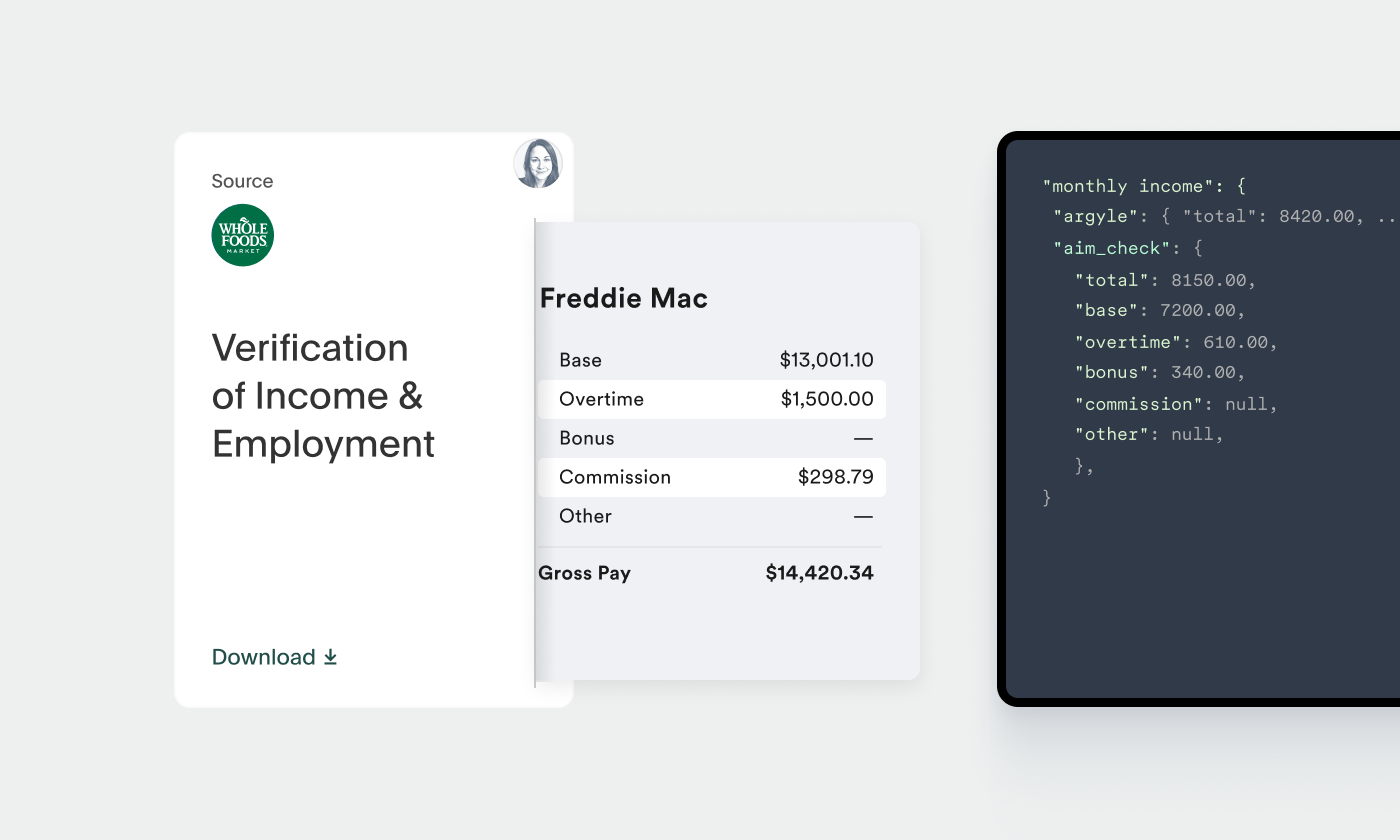
This is the gap VOIE+ was built to close. Direct VOIE+ delivers calculated monthly income from Freddie Mac’s AIM Check API alongside the direct-source payroll data applicants share through Argyle, in the same report.
- Two perspectives, one report. Review consumer-permissioned payroll data next to Freddie Mac's calculated monthly income, broken out across base, overtime, bonus, commission, and other income, so you can see exactly what's driving the number.
- Built for complex files. Freddie Mac's calculation is matched to each employment, including for applicants with more than one employer. If Freddie Mac doesn't return a calculation, you still receive the payroll data.
- In the formats you already use. Freddie Mac's calculated monthly income appears in each employment section of the PDF, with Freddie Mac's Findings Report included, and is returned in the JSON alongside the existing Argyle income fields.
- No workflow change. Direct VOIE+ is enabled at the organization level, with no new order type. Once it's on, every mortgage verification your team runs includes Freddie Mac's calculation.
If your team already uses Argyle's Direct VOIE solution, Direct VOIE+ is an upgrade to the verification you're already ordering, not a new process to roll out.
Questions to ask about your own income workflow
Before your next pipeline review, it's worth answering a few questions honestly:
- When does your team first see a qualifying income number? At application, at processing, or at underwriting?
- How often does underwriting's number differ from the loan officer's? And how many of those files need restructuring or re-disclosure?
- What share of your income conditions come from variable pay or multiple employers? These are the files where an early agency calculation matters most.
- How many income findings show up in post-close QC? And how many of them trace back to a calculation, not a document?
If the answers point to underwriting as the first time income comes into focus, there's an opportunity to move it earlier.
The bottom line
Lenders have spent years speeding up how income gets verified. The next step is changing when it gets understood. When direct-source payroll data and the GSE qualifying income calculation arrive together, loan officers can structure loans right the first time, underwriters can confirm instead of rebuild, and borrowers can move forward without a late surprise.
To learn more about Direct VOIE+ or enable it for your organization, reach out to our team or contact your Argyle CSM.