Argyle vs. Plaid for Payroll Connectivity: What Tenant Screeners Should Look For


In the National Multifamily Housing Council's 2024 Pulse Survey, 93.3% of apartment owners and managers reported experiencing fraud in the prior 12 months. The most common form, reported by 84.3% of respondents, was falsified or fabricated pay stubs, employment references, or other income documentation. With generative AI now able to produce a convincing pay stub in under a minute, tenant screeners are moving income and employment checks off documents and onto data applicants share straight from their payroll accounts.
That raises a practical question: which provider should you use for payroll connectivity? Argyle and Plaid both offer it, and they approach it differently. This guide focuses on payroll, covers where banking fits, and gives you the questions to ask any provider.
Why payroll first
A payroll connection works like this: the applicant finds their employer or payroll provider, logs in to their own account, and shares their income and employment data with you. What comes back is the direct-source payroll information and documents (paystub PDFs), including gross and net pay, pay period start and end dates, employer, employment status, hire date, pay frequency, and deductions. None of it is inferred.
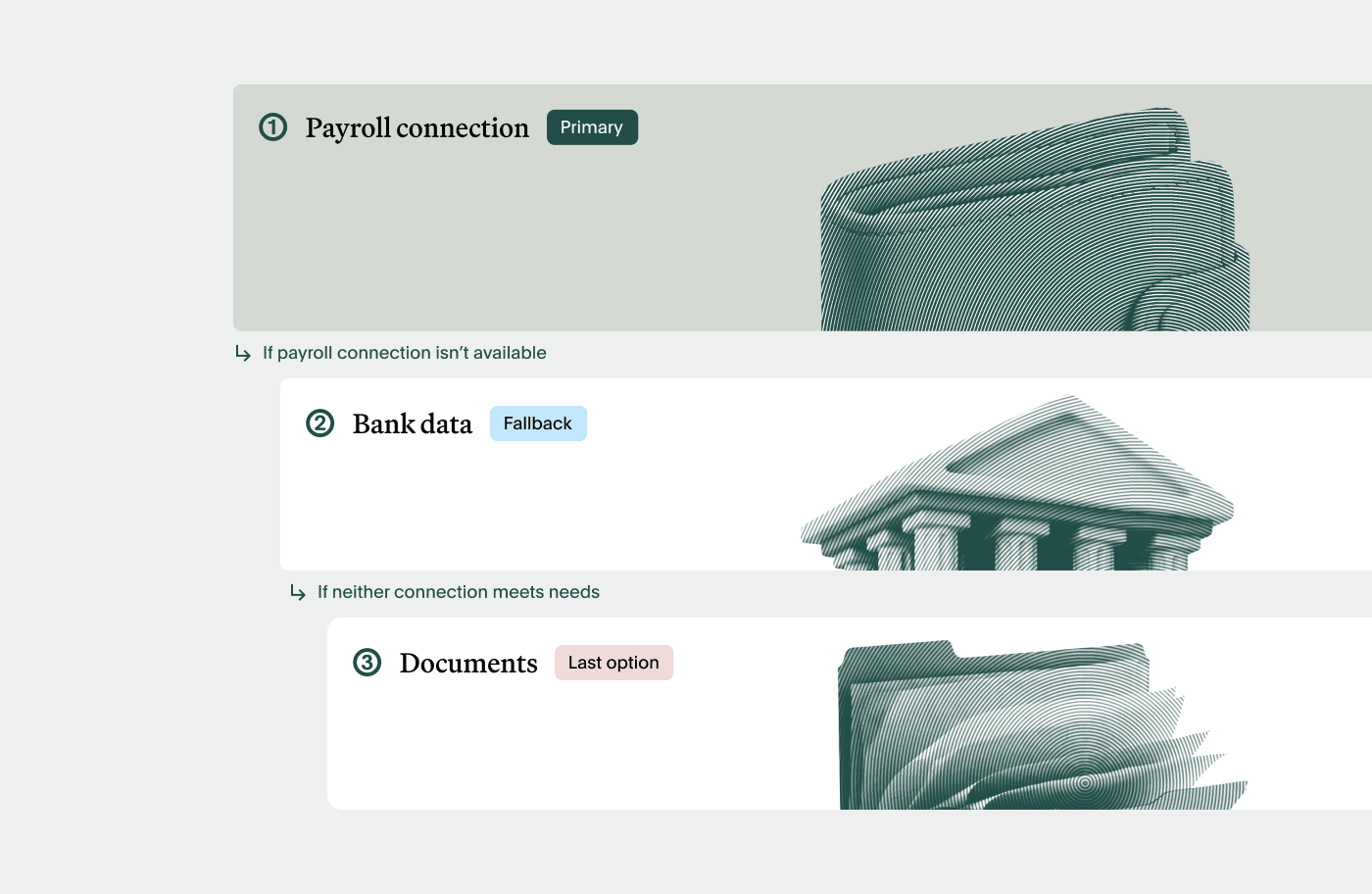
That matters for tenant screening, where rent-to-income ratios are usually written against gross income and a missed job change can mean a bad lease. Bank data is valuable too, because it sees all the money, including cash deposits and 1099 income that never touch payroll. But deposits are net, and a descriptor isn't an employer of record. We cover the trade-offs in Payroll vs. Banking Data: A Tenant Screener's Guide to Direct-Source Income. The short version: start with payroll, fall back to banking, and keep documents as the last resort.
How Argyle and Plaid approach payroll connectivity
Plaid built its business on open banking, and its income solution leads with real-time bank data. Payroll is offered as Payroll Income, which supports approximately 80% of the U.S. workforce, including gig workers. Document Income is available as a fallback when a payroll provider isn't supported.
Argyle is a consumer-permissioned verification platform that starts with payroll. Its platform covers 91% of the U.S. workforce, including more than 30 gig platforms plus VA and Social Security benefits. If an applicant can't connect payroll, they can share bank data (powered by Mastercard Data Connect) or upload documents in the same flow, with required fields populated at up to 95% completeness.
What to ask any payroll connectivity provider
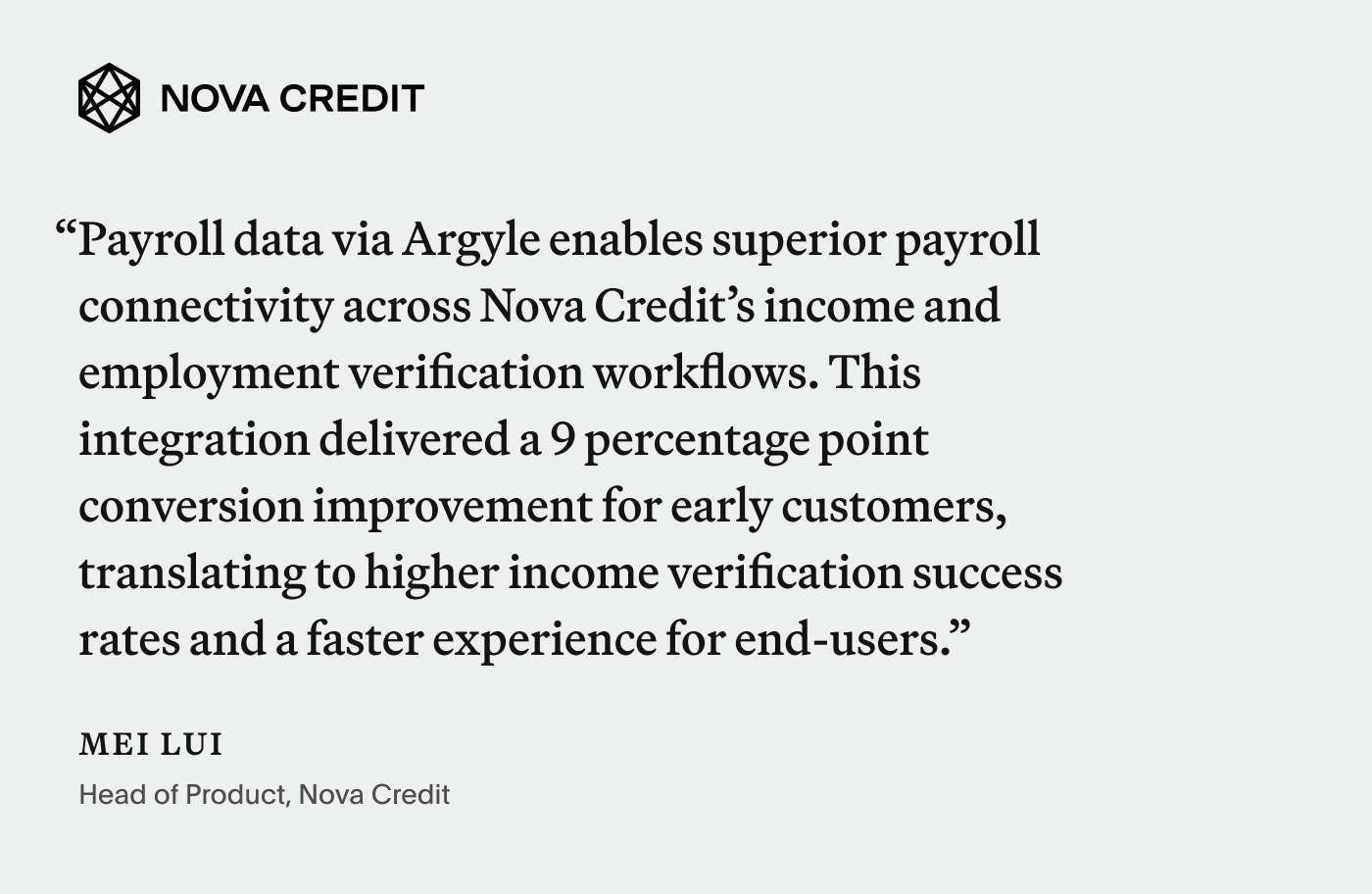
1. How many of my applicants will connect? Coverage is only half of the answer. What counts is the share of applicants who finish the connection. Argyle sees 55%+ conversion, and tenant screening customers have reported 10% higher income verification completion rates (SafeRent) and a 30% increase in application completion (Snappt). Ask any provider, Plaid included, for conversion numbers from tenant screening customers, not blended averages across industries. Customer references are always helpful to back up the numbers.
2. Does coverage match how my applicants earn? Roughly 80% versus 91% workforce coverage is a real difference at scale, and the gap can matter more for the applicants you're most likely to lose. Ask about gig platforms, government benefits, and applicants with more than one income source. At Inhabit, 40% of applicants have income from more than one source.
3. Are your payroll connections built in-house? Confirm that payroll connectivity is proprietary, as it flows down to the support function and granularity of information retrieved via the API. At Argyle, all possible errors are accounted for, with clear next steps for consumers and visibility for customers.
4. What data do I get, and how complete is it? Confirm that gross pay, employer, employment status, and hire date come back populated for your applicant mix, and ask what "complete" means in practice.
5. How do you support customers? Ask about additional costs for implementation and support, and how customers are provided resources to succeed throughout the implementation and beyond. Whether you can embed the connection flow in your application, send applicants a link, or use a no-code console, and how quickly you can go live. Inhabit found that embedding verification directly in its online application increased completion, now completing 90% of income verifications entirely through digitally sourced data.
Where Plaid may be the right fit
Plaid is a strong choice if your screening is already built around bank connectivity or if cash flow underwriting is your priority. Its 12,000+ institution network is a real asset, and its property management solution bundles identity, income, and payments. Teams that primarily want to evaluate bank data will find that Plaid's income solution is built around it.
Where Argyle may be the right fit
Argyle fits if you optimize for gross income and paystub availability, payroll is your primary income source and you want the highest payroll coverage and conversion, particularly for W-2, hourly, and gig earners. It also fits if you want banking and document fallbacks in a single connection flow and a platform designed for tenant screening workflows.

The bottom line
Both companies can replace forgeable documents with data applicants share directly from the source. The right choice comes down to what you want your screening flow to lead with. If it's payroll, test providers on applicant conversion, coverage that matches your applicants' income, and what happens when the first method doesn't work.
To see how Argyle's payroll connectivity could work in your current workflow, reach out to our team.