5 Myths About Mortgage Verification That Are Costing Lenders Money


Mortgage margins are thinner than they've been in years, and every line item on a loan file is getting a second look. Verification of income and employment (VOIE) and verification of assets (VOA) should be one of the easiest places to cut cost and cycle time, since consumer-directed, direct-source data has been GSE-eligible for years. Yet a handful of persistent myths are still keeping lenders tied to slower, more expensive, database-driven workflows.
Some of these myths were true once. Others never were. All of them are worth re-examining against what leading lenders are actually seeing in production today. Below, we debunk five of the most common misconceptions about modern verification, using real results from lenders who've made the switch.
Myth #1: Moving verification to the point of sale will drive up costs
This is the objection we hear most often, and it's understandable. If you ask borrowers to connect their payroll or bank accounts at the point of sale (POS) instead of later in the loan origination system (LOS), you'll generate more verification requests overall, including for applications that never close. On the surface, that looks like more spend, not less.
In practice, lenders who've run the numbers have found the opposite. Verifying earlier means capturing dramatically more GSE-eligible data at a lower per-file cost, and that math wins even when you build in a healthy discount for pull-through.
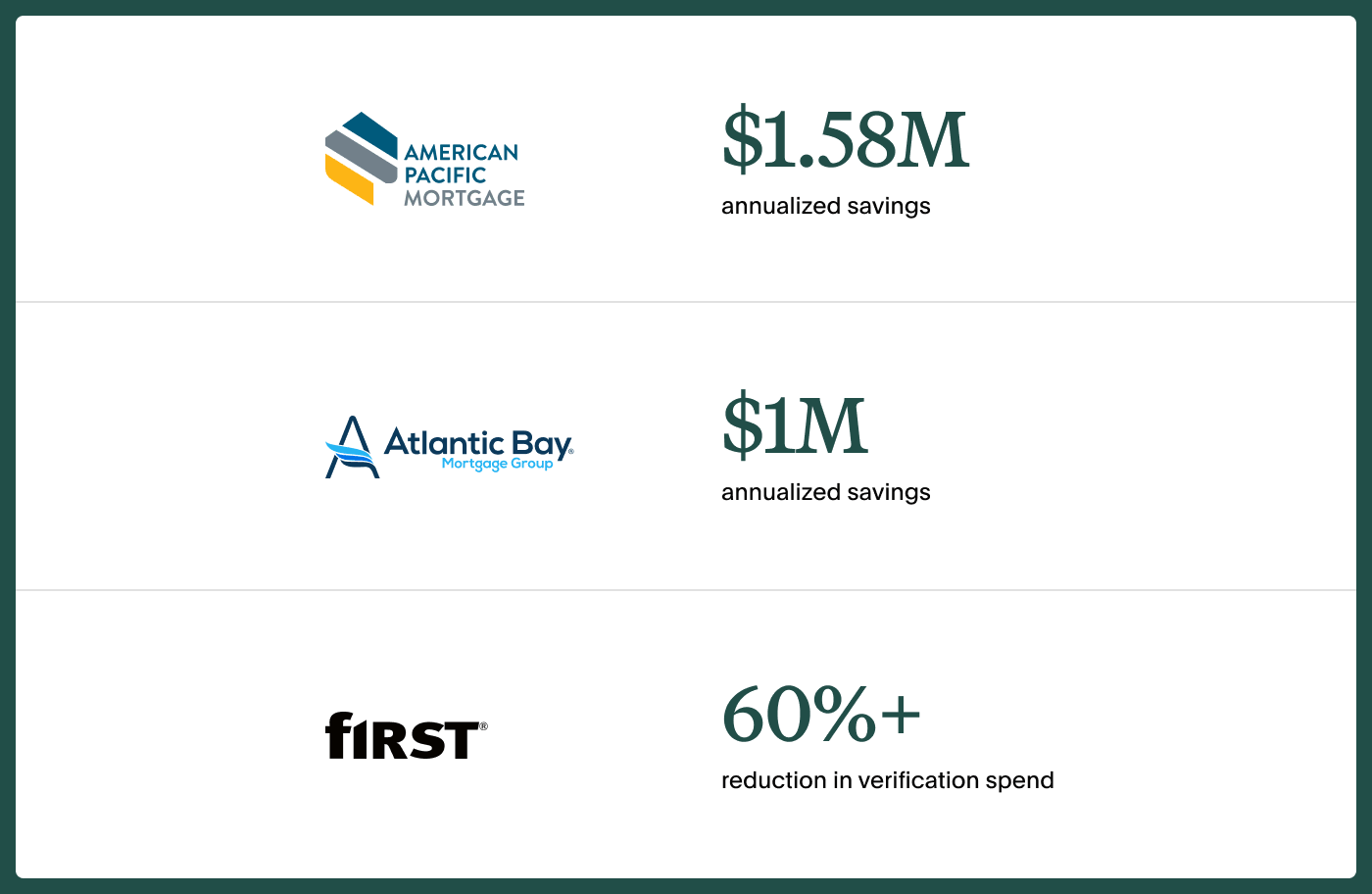
American Pacific Mortgage (APM) worked through this exact concern before rolling out consumer-directed verification by default in its nCino POS. "We did the math," said Chris Sutherland, APM's Director of Production Strategy. "We asked, what if we take five or 10% off that expected success rate and get really conservative? There's only upside built into this equation." The result: APM saved $700,000 in verification expenses in the first five months after moving verification to the POS, putting the lender on pace for $1.58 million in annual savings and a 12.5-day reduction in cycle time from application to funding.
Atlantic Bay Mortgage Group had the same worry and reached the same conclusion. After embedding Argyle at the front of its loan application in nCino, Atlantic Bay estimates it's on track for nearly $1 million in annualized verification cost savings, driven by routing fewer borrowers to costlier legacy verification methods. "The astronomical costs of verification that we were paying out every single month just kept growing and growing," said John Wines, Atlantic Bay's Chief Strategy Officer. "We needed to find alternative ways to do it."
First Financial Bank moved its verification workflow upstream into nCino as well, after finding that database verifications were often costing more than $140 per file. Shifting income and employment verification to the point of sale, with document-based verification as a fallback, cut First Financial's overall verification spend by more than 60%.
The pattern holds across lenders:
- More verification volume at the POS, but a lower cost per file, adds up to net savings, not net cost.
- More completions happen while borrower engagement is highest, which means more of those verifications are usable, GSE-eligible data.
- The savings compound with volume. As one lender put it, the reduced cost of manufacturing the loan becomes a predictable baseline, not a variable risk.
Visual Callout: Pull the three lender numbers together into one comparative graphic: APM's $1.58M annualized savings and 12.5 day cycle time cut, Atlantic Bay's nearly $1M annualized savings, and First Financial's 60%+ reduction in verification spend.
Myth #2: Borrowers won't want to connect their accounts
Asking a borrower to log into their payroll or bank account, feels like a bigger ask than uploading a pay stub. Lenders worry it will suppress completion rates or hurt satisfaction scores, especially with borrowers who already have a strong relationship with the institution.
The data says otherwise. Atlantic Bay was concerned enough about this that leadership debated it internally for months before launch. Once live, loans where borrowers connected their accounts through Argyle scored one point higher on NPS than loans where they didn't. "We were able to go back to the sales team and say, your borrowers are not upset with this experience," Wines said. "If you're hesitant, that's a you thing, not a borrower thing."
First Financial has seen a consistent connection rate of around 50% when borrowers are prompted at the point of sale, a rate the team attributes largely to how loan officers set expectations early in the process. And APM's experience went further: once verification became a built-in step in the application rather than a separate request, completion rates "absolutely hockey-sticked," according to Sutherland.
Visual callout: Atlanta Bay quote: "We were able to go back to the sales team and say, your borrowers are not upset with this experience," Wines said. "If you're hesitant, that's a you thing, not a borrower thing."
Myth #3: Direct-source, consumer-permissioned data isn't good enough for GSE loans
This myth tends to linger among teams still comparing consumer-directed verification to older database products. In reality, direct-source VOI, VOE, and VOA data that consumers share straight from their payroll or bank accounts already qualifies for Fannie Mae's Desktop Underwriter (DU) validation service and Freddie Mac's Asset and Income Modeler (AIM), and can support representations and warranties (R&W) relief when reports meet GSE formatting standards.
First Financial has used document-based verification, built on the same underlying data quality standards, to increase its R&W relief significantly, reducing the need for follow-up documentation like tax transcripts. Atlantic Bay reports similar gains, with direct-source data helping flip borderline loans into approve-eligible outcomes in DU more consistently, and refreshable reports removing the need to chase borrowers for updated pay stubs before closing.
Myth #4: Direct-source verification only works for traditional W-2 employees
Lenders sometimes assume consumer-permissioned verification is a good fit for salaried employees at large companies but a poor one for gig workers, federal employees, or borrowers with variable income. Coverage has moved well past that assumption. Leading verification platforms built for the mortgage industry now cover over 90% of the U.S. workforce, spanning traditional W-2 employees, gig and contract workers, and federal employees, with document-based verification (Doc VOI) available as a fallback when a direct account connection isn't an option.
That fallback matters in practice. It's what allows lenders like First Financial to make consumer-permissioned verification the primary method in their waterfall, rather than one solution among several, because there's always a next-best option rather than a dead end.
Myth #5: This is just a cost play, not a borrower-experience or risk play
It's tempting to treat modern VOIE purely as a line-item savings story, but the lenders seeing the biggest results are the ones who treat it as an operating model change. Faster verification at the POS means processors open files that already contain complete, real-time income and employment data, which shortens the runway to underwriting and reduces the back-and-forth that frustrates both loan officers and borrowers. It also reduces income misrepresentation risk, since data comes straight from the source rather than from a document a borrower uploaded or a database that may be weeks out of date.
The lenders featured here didn't set out to prove a point about myths. They set out to solve real cost, speed, and experience problems, and the results reshaped how they think about verification altogether.
Visual callout: Three short phrases: lower cost per file, faster cycle time, better borrower experience.
What this means for your organization
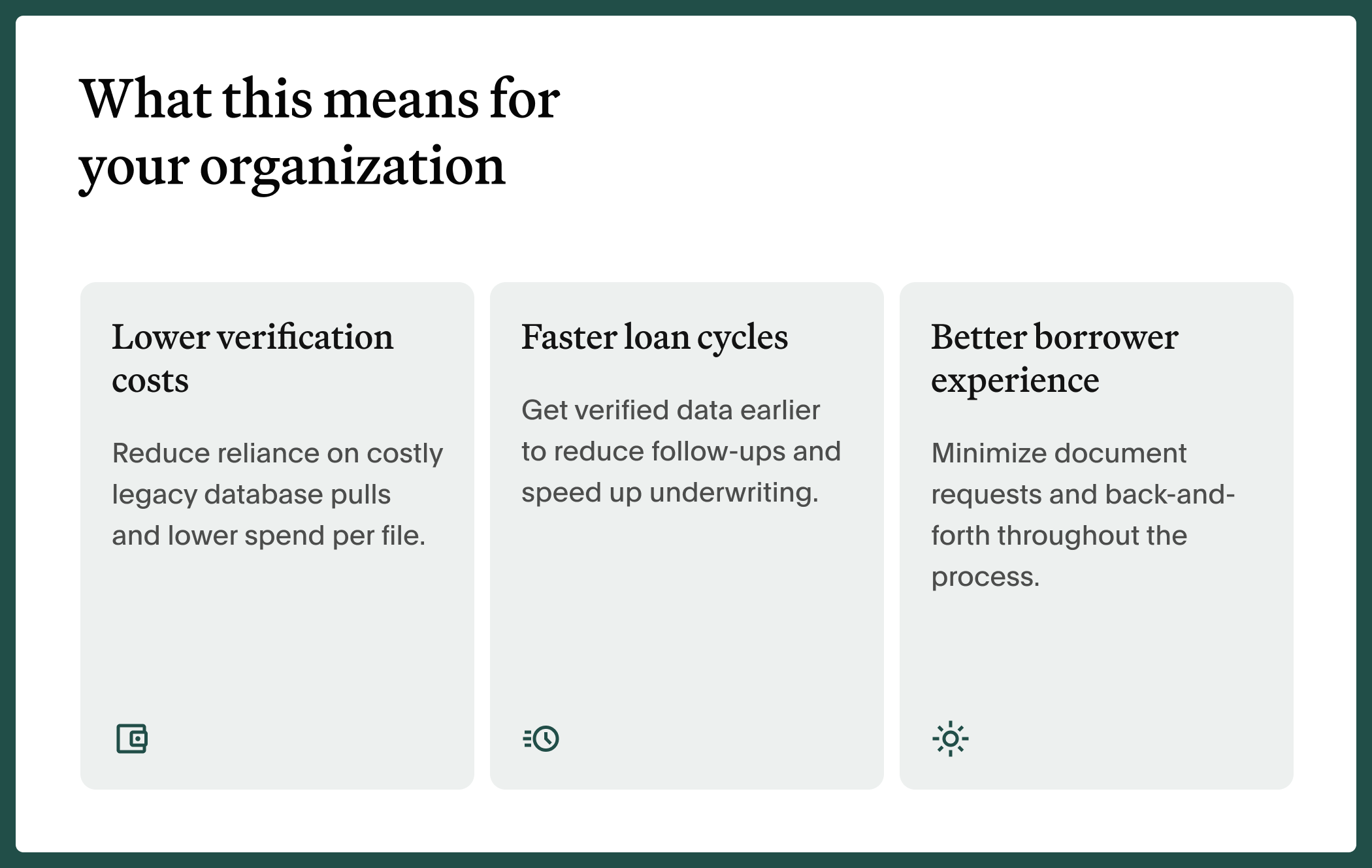
If your team has been holding off on moving VOIE to the point of sale, or defaulting to legacy database verification because "that's how it's always been done," it's worth running the same math these lenders did. Build in a conservative pull-through assumption, compare it against your current per-file verification cost, and see where the numbers land. For most lenders, they land in the same place: more savings, faster cycles, and a better borrower experience, not a bigger bill.
You can see more results like these across mortgage lenders of every size in our customer case studies, including First Financial Bank, Atlantic Bay Mortgage Group, and American Pacific Mortgage.
Ready to see what a consumer-permissioned verification waterfall could save your organization? Reach out to our team to talk through your numbers.