The Case for Consent-Based, Direct-Source Verifications in Determining Medicaid Eligibility

Faster decisions, lower costs, and improved access are just some of the benefits of a verification transformation
State Medicaid agencies are entering one of the most demanding eligibility verification environments in the program's history. The passage of H.R. 1 in July 2025 introduced mandatory work requirements for adults enrolled through the ACA's Medicaid expansion. As a result, states are required to verify that enrollees are engaging in at least 80 hours per month of qualifying work or community activities—and to do so using ex parte data wherever possible.
The administrative burden this creates is substantial. States will need to verify income and employment status more frequently, for more people, and under tighter timelines—all while limiting coverage losses among people who are genuinely eligible. As the Center on Budget and Policy Priorities (CBPP) notes in its guide to reducing coverage losses through effective implementation of Medicaid's new work requirement, the biggest risk is that eligible people will lose coverage simply because they can't navigate the paperwork.
That's where verification technology matters. Consent-based, direct-source data offers a path for state agencies to meet their new obligations faster, at lower cost, and with less risk of procedural denials.

The problem with "paper first" verifications
For years, income and employment verification in Medicaid has relied heavily on a manual, document-centric process. Applicants are asked to submit paystubs, employer letters, tax forms, and other records—often multiple times across a single application cycle. Eligibility workers then manually review those documents, chase missing materials, and make judgment calls about what counts.
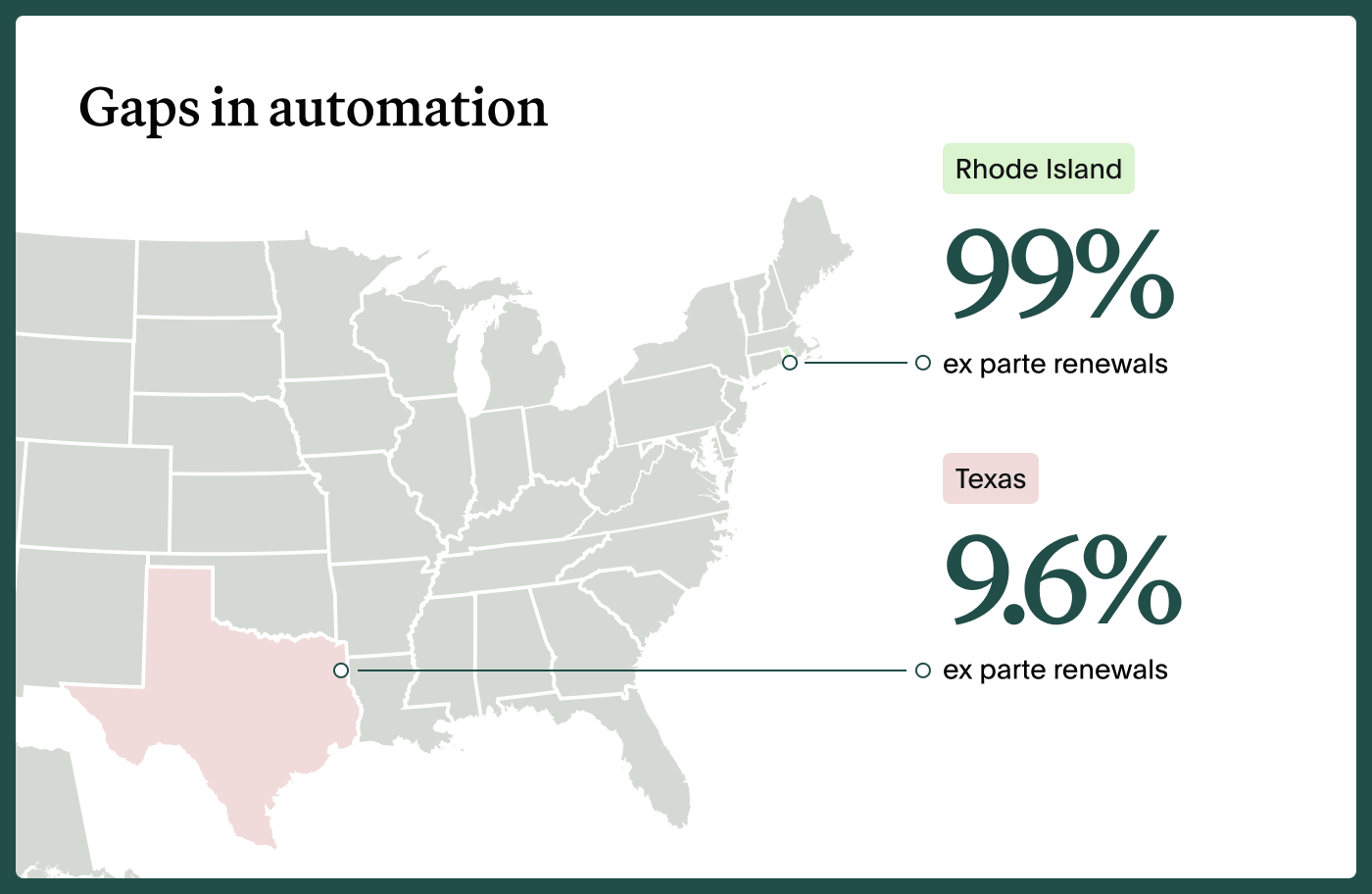
This approach creates bottlenecks at every step. In the first quarter of 2025, the share of Medicaid applications taking more than 30 days to process ranged as high as 72% in some states, suggesting significant backlogs and heavy reliance on paper-based processes. Meanwhile, ex parte renewals (defined as when states confirm eligibility using available data without requiring action from applicants) varied widely from just 9.6% in Texas to 99% in Rhode Island. This reveals a massive gap in how prepared states are to shift toward automated, data-driven verification.
The consequences of document-heavy processes fall disproportionately on the people Medicaid is designed to serve. Gig workers, people with variable income, and those juggling part-time jobs struggle to produce clean documentation on demand. People without reliable internet access or printer access have difficulty uploading documents on short notice. And anyone who misses a deadline may face a gap in coverage that's harmful to their wellbeing.
The CBPP's guide puts it plainly: Many individuals "risk losing coverage anyway if they are unable to navigate the intricate maze of the work-reporting requirements." And legacy verification processes make that maze harder to escape.
The limits of legacy data sources
It's not just paper documents that create problems. Many states rely on verification databases—most notably The Work Number from Equifax—to pull employment and income records. While these databases have their place, they carry significant limitations for Medicaid verification.
One issue is coverage. Verification databases aggregate records through employer agreements, which means their data skews heavily toward large, traditional employers. Workers in the gig economy, self-employed individuals, and those with multiple part-time jobs are routinely underrepresented or missing entirely. For a Medicaid population that disproportionately includes these non-traditional workers, that's a significant gap.
There's also a cost problem. Legacy verification providers charge per lookup, and those costs add up quickly—especially as verification frequency increases under the new work requirement regime. As lookup volumes rise, per-transaction costs from legacy providers can become fiscally unsustainable.
How consent-based, direct-source verification can help
Consent-based, direct-source verification methods work differently. Rather than querying a static database, applicants connect directly to their payroll provider, employer, gig platform, or bank account and, at their direction, share income and employment data from the system of record in real time.
This approach offers several concrete advantages for Medicaid agencies navigating the new work requirement landscape:
Broader income coverage. Direct-source platforms cover W-2 employees, 1099 contractors, gig economy workers, and those with multiple income streams. The CBPP guide explicitly recommends states use consent-based verification tools to capture income from self-employed and non-traditional workers—a gap that legacy databases can't reliably fill.
Significant cost savings. Argyle's direct-source verification platform can reduce verification costs by up to 90% compared to legacy providers like The Work Number. For agencies facing rising verification volumes and constrained budgets, that kind of efficiency gain isn't incremental—it's transformational.
Reduced applicant burden. When applicants can share income and employment data automatically, at their direction, they don't need to locate, scan, and submit documents. This is especially significant for enrollees who lack reliable internet access, are managing multiple jobs, or are being asked to reverify every six months under the new renewal schedule. The CBPP guide emphasizes building mobile-friendly, user-centric application and renewal pathways to reduce coverage losses. Consent-based, direct-source verification directly supports this goal by cutting the steps applicants must take.
Fraud prevention. Fake paystubs and misreported income are persistent challenges in benefits verification. Because consent-based, direct-source data comes directly from the system of record rather than a document submitted by the applicant, the risk of fraudulent documentation drops significantly.

How operational efficiencies improve access and outcomes
Critically, with consent-based, direct-source verification, income and employment data can be validated in real time. States can use this data not just to verify income thresholds but—under H.R. 1—to identify whether someone's monthly income is at or above $580 (the equivalent of 80 hours at federal minimum wage), which automatically satisfies the work requirement without any further documentation. This supports faster eligibility decisions and reduces the need for manual follow-up on stale or incomplete records.
These efficiencies come with a number of advantages for states and the people they serve:
- Reduced procedural denials and churn
Verification delays and documentation demands are among the largest drivers of Medicaid churn. Arkansas provides the clearest cautionary example: When the state ran a Medicaid work requirement program in 2018, approximately 18,000 people lost coverage—largely due to administrative hurdles, not actual ineligibility.
By reducing manual interventions, accelerating application processing, and preventing backlogs, consent-based, direct-source verifications reduce the likelihood of document errors and the risk that eligible individuals lose coverage simply because they missed a step or ran out of time.
- Enhanced program integrity and accuracy
Real-time connections to payroll data don't just help enrollees—they also give agencies better data. Because the information comes directly from the source rather than from an applicant-submitted document, the risk of misreported income or fraudulent paystubs drops significantly. That supports robust audit trails, reduces error rates, and allows eligibility workers to focus on genuinely complex or ambiguous cases rather than routine verifications. States can meet their accuracy and compliance obligations under federal rules while operating more efficiently.
How lower operational costs enable scale and sustainability
Under a traditional verification model, eligibility staff spend substantial time chasing missing documents, responding to applicant inquiries about what to submit and how, and manually reviewing and filing the documents they receive. That labor is expensive—and it scales linearly with volume.
Direct-source verification shifts the effort to applicant-directed data sharing, freeing caseworkers to focus on exceptions, edge cases, and the higher-value work that genuinely requires human judgment. The benefits are tangible:
- Streamlined eligibility workflows and renewals
Without automation, heavier determination requirements translate to proportionately heavier workloads for eligibility staff. But consent-based, direct-source verifications makes it possible to handle higher volumes without a proportional increase in staff or cost since much of the process is automated. - Cost-efficient scaling as caseloads grows
As Medicaid caseloads grow, a verification architecture that relies heavily on manual processes and high per-lookup costs from legacy vendors cannot sustainably keep pace. Scalable, direct-source infrastructure allows agencies to handle growing volumes while keeping per-verification costs low—protecting both the program budget and the capacity to serve eligible enrollees.
Strategic access improvements for beneficiaries
At the same time, consent-based, direct-source verifications reduce friction for vulnerable populations who would otherwise struggle with documentation processes—applicants like older adults, people with certain disabilities, and those with multiple part-time jobs or inconsistent income who can't produce clean documentation on demand. Direct-source verification simplifies the process for all of these groups by removing the document collection step.
This is in line with CBPP guidance, which emphasizes that user-friendly portals, mobile-accessible design, and simplified document requirements are critical for protecting access. Consent-based, direct-source verification is foundational to delivering on all three.
Moreover, by capturing income from nontraditional sources—gig platforms, 1099 work, part-time and seasonal employment—consent-based, direct-source verification ensures that eligible people aren't excluded simply because their income doesn't fit neatly into legacy database categories. Closing the data gap helps close the coverage gap.
Consent-based, direct-source verifications also cultivate affinity for benefit programs. A streamlined process—faster decisions, fewer uploads, less back-and-forth—builds applicant trust and reduces drop-off during the enrollment process. That trust translates into better retention, since applicants who have a good experience are more likely to complete future renewals.
Why Argyle is positioned to support Medicaid's verification transformation
Argyle's verification model is built on direct connections applicants make to their own payroll accounts, sharing data at their direction. This aligns precisely with the CBPP's recommended approach of consent-based verification for income and employment data—and with H.R. 1's mandate that states verify compliance ex parte using reliable data sources wherever possible.
State agencies also benefit from Argyle's:
- Transparent, predictable pricing
Argyle's model provides predictable, per-verification pricing that doesn't fluctuate unpredictably with caseload volume—a meaningful contrast with legacy providers whose costs can be opaque and difficult to control at scale. In turn, Argyle enables agencies to budget with confidence. - Broad coverage across income types
Argyle covers W-2 employees, 1099 contractors, gig economy workers, and those with multiple concurrent income streams. For a Medicaid population that includes a significant share of non-traditional workers, that breadth of coverage is essential for accurate and equitable verification. - Ease of integration
Argyle is designed to fit into existing state workflows, not replace them. The platform supports a data waterfall approach—direct-source verification first, document request as a fallback—consistent with the CBPP guide's recommendation to automate wherever possible and ask applicants for documentation only when automated sources are insufficient. Argyle also recently secured a U.S. GSA Multiple Award Schedule contract, giving state agencies a streamlined procurement path at pre-negotiated pricing. - Structured, integration-ready reporting
Argyle generates structured verification reports that integrate with eligibility and decisioning systems—giving agencies visibility into verification performance over time. This supports the kind of ongoing monitoring the CBPP guide recommends: tracking procedural denial rates, identifying workflow bottlenecks, and continuously improving verification outcomes.

Modernizing Medicaid verification for the future
The demands on state Medicaid verification systems are only going to grow, and as the CBPP guide notes, "states must act quickly to change application and renewal forms, add data sources, modify systems."
Fortunately, there's a solution. Consent-based, direct-source verifications don't just reduce cost and workloads in this environment—they preserve access. It's what allows more eligible people to stay covered, with less churn and fewer gaps.
Agencies that invest in this kind of verification infrastructure now will be meaningfully better positioned for whatever comes next—whether that means expanding eligibility populations, additional policy changes, or simply higher workloads. And Argyle is built to serve as the verification backbone enabling that transition.
The bottom line
The CBPP's guidance is clear: States that implement effective verification systems—minimizing applicant burden, automating wherever possible, and monitoring performance over time—will protect more eligible people and spend less doing it. Those that don't will pay the price in staff costs, churn, and coverage losses.
Consent-based, direct-source data offers state agencies a fast and powerful way to meet the CBPP's guidance, and Argyle is ready to help you get there. Learn more about how Argyle supports Medicaid eligibility determinations or contact our team with questions.